
Nigeria’s banks have hardly ever been in higher well being. They have simply been recapitalised, they’re posting a few of the largest earnings of their historical past, and they’re full of money.
In the similar nation, at the similar second, a enterprise with an actual order and a sound plan can hardly ever get a mortgage, and when it will probably, the worth is punishing.
Both issues are true without delay, and the cause they’re true collectively is shut to the coronary heart of why a trillion-dollar economic system stays out of attain.
How can a banking system be this wealthy whereas the economic system it serves is this starved? The reply is not a scarcity of money. Nigeria has quietly constructed a system that may relatively lend its money to the authorities than to the businesses meant to make the nation wealthy.
This is stranger than the grievance we normally hear that rates of interest are too excessive, and it is not solely the banks. The banks do it, the pension funds do it, the insurers do it: every finds the authorities simpler and safer to finance than a enterprise, and every, by itself phrases, is proper.
The sum of all these smart decisions is a rustic whose financial savings pile up behind the state whereas its businesses go unfunded. The outcome, greater than any single rate of interest, is a rustic that can’t get its personal money to its personal businesses. What follows is how that occurred, and why it issues.
Start with the quantity everybody watches. In September, the central financial institution lower its coverage price to 23%, and the headlines learn it as the worth of money falling. But the coverage price is not the worth of money in Nigeria. Ask a enterprise what it really pays to borrow and the reply is 30% to 46%, if a financial institution will lend in any respect, whereas a saver earns about 8%. The price the central financial institution pronounces and the price a enterprise is charged are two totally different worlds, and it is the second that decides whether or not something will get constructed.
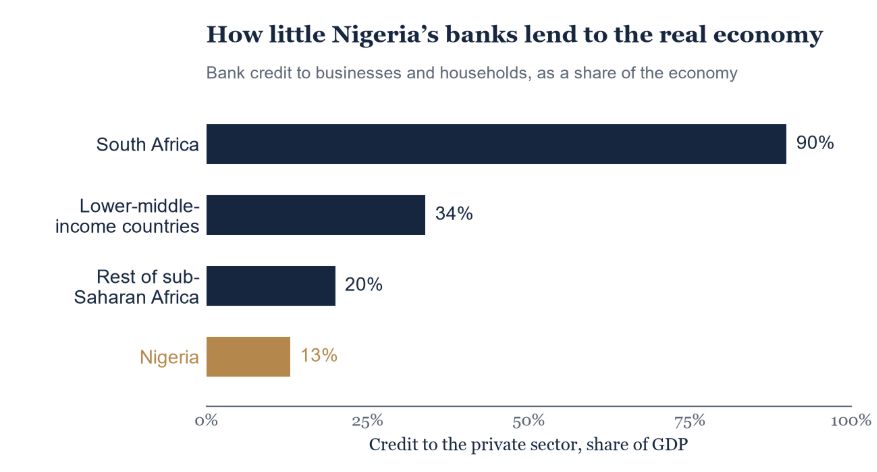
Behind that worth sits a deeper reality: Nigeria’s banks lend strikingly little to the actual economic system. All their loans to each enterprise and family collectively come to round 13% of the measurement of the economic system, towards about 20% throughout the remainder of Sub–Saharan Africa and close to 90% in South Africa.
A system that lends its complete productive economic system the equal of an eighth of nationwide output is not financing development; it is sitting beside it. And the little it lends goes to a slender few: fewer than one in twenty of the nation’s roughly 40 million small and medium businesses have a financial institution mortgage, and such corporations share about 1% of all credit score. The corporations that make use of most Nigerians run on the proprietor’s financial savings, household money and casual lenders at punishing charges, starved of the one factor they need, different folks’s capital put to work.
There is nothing depraved or lazy or unpatriotic on this. The banks are merely being rational. For a Nigerian financial institution, no borrower affords the authorities’s mixture of benefits. It pays about 18% to 19% by itself paper, which a financial institution can deal with as sure to be repaid as a result of it is owed in naira.
Lending to it requires no collateral and little evaluation, and below the guidelines banks reside by it carries virtually no threat weight. Set that beside a mortgage to a producer, which might default, has to be assessed, and ties up capital for years. Why take the second when the first pays almost as a lot for none of the bother? So, newly recapitalised and full of money, the banks did the rational factor. They lent to the state.
You can see the alternative in the banks’ personal accounts. At the largest lenders, loans to businesses and households come to solely a couple of fifth to 1 / 4 of complete belongings; the relaxation sits largely in authorities securities, money and placements, a few of it wanted for liquidity and security, a lot of it merely the place the banks would relatively be.
At a few of the largest, holdings of presidency securities now rival and even exceed the total mortgage ebook. And the banks usually are not straining for revenue: every of the largest earned between about N90 billion and N360 billion in revenue earlier than tax in the first quarter of 2026 alone.
There is a tough lesson on this about the current reform. Nigeria made its banks increase recent capital, on the principle that stronger banks would lend extra. But capital is solely the capability to lend, not a cause to. Offered the similar simple and profitable authorities paper, the banks largely turned their new capital into extra of it. A greater capitalised financial institution, it seems, is not the similar factor as a greater financed economic system. The central financial institution’s personal Governor has stated as a lot, noting that banks positioned the capital they raised in authorities securities relatively than in loans to enterprises.
There is a second half to this, and it is solely honest to state it. Even a financial institution that wished to lend to the productive economic system would typically discover it arduous. An amazing many Nigerian businesses can’t simply be lent to: they maintain no dependable accounts, maintain no title a financial institution can take as safety, and haven’t any credit score document a lender can verify. So two issues feed one another. Banks desire the authorities as a result of it is simple and protected to lend to, and far of the actual economic system is genuinely troublesome to lend to. The outcome is the similar, capital pooling the place it is snug and avoiding the place it is wanted, however any remedy has to deal with each halves.
The guidelines deepen the pull. Under the money reserve requirement, banks should lodge a big share of each deposit, 45%, with the central financial institution, out of attain of lending. Government paper takes a lot of the relaxation. What lastly reaches a enterprise, after carrying the actual price of threat, evaluation and years of ready, is the expensive the rest. Given all that, the actual shock is that any credit score reaches the productive economic system in any respect.
Nothing reveals this extra plainly than the pension funds, the place a rustic retains its most affected person money, the retirement financial savings of its employees constructed up over a long time. Nigeria’s pension pool has grown to about N31.8 trillion. More than half of it, round N17.8 trillion, is lent to the similar borrower as all the pieces else, the federal authorities.
If even the long run financial savings of the nation circulation to the state relatively than to the businesses that may grow it, the bother is not one financial institution’s warning or one quarter’s rates of interest however the form of the complete system, during which a financial institution finds authorities debt less complicated to decide than a mortgage to an unfamiliar agency, and a pension fund finds it less complicated to maintain than a stake in an unlisted firm. Each is appearing faithfully for the folks whose money it retains. The sum is a rustic that funds its authorities handsomely and its producers barely in any respect.
This is why the sample issues a lot for the trillion-dollar ambition. A trillion {dollars} is constructed when businesses make investments: a brand new manufacturing line, an even bigger manufacturing unit, a chilly retailer, a second department, a primary severe machine. It doesn’t come from a authorities spending extra, or from banks and funds clipping coupons on its debt.
Investment on that scale wants capital that is reasonably priced, obtainable, and affected person. Nigeria’s credit score is none of the three. It is too pricey to make most investments pay, too scarce to attain most corporations, and too quick to fund something that takes years to construct. A monetary system that may relatively lend to the state is not going to simply finance the industries a trillion-dollar economic system is product of.
I see this from the different facet of the desk. As an investor in Nigerian businesses, I spend virtually as a lot time on whether or not a superb firm could be financed in any respect as on whether or not it is any good. The debt on supply, when it is on supply, is normally too pricey and too quick to construct something with, so fairness is compelled to do work {that a} financial institution elsewhere would share.
That is why affected person capital that shares the threat, fairness, ensures, longer tenors, is not a luxurious right here; it is typically the solely factor that will get a enterprise constructed. And it is why the pension and insurance coverage swimming pools matter past their measurement: turned even partly in direction of manufacturing, they may change what is fundable on this nation. The constraint was by no means solely the provide of excellent businesses, although Nigeria wants extra of these too. It is a monetary system that has scarcely realized to discover and again the ones it already has.
Ordering banks to lend is not going to repair this; it solely pushes credit score at businesses with out making them safer to lend to. Forcing charges down by decree is not going to repair it both. The actual objective is narrower and more durable: a monetary system that may discover a viable enterprise, decide it, and fund it in the kind it really wants.
Much of the equipment for the judging already exists and wishes deepening, not inventing: a nationwide registry the place a agency can pledge movable belongings, its gear, inventory or receivables, not solely land; credit score bureaus a financial institution can use to verify a borrower it has by no means met; and the transaction trails cellular money now leaves, which start to let a lender see a dealer’s actual money circulation. The hole is attain and enforcement: most small corporations sit in none of those methods, and a lender that does take safety nonetheless struggles to implement it in courtroom. And as a result of not each enterprise ought to carry debt, the capital should come in additional shapes than a mortgage, fairness, leasing, and ensures that share the threat, which is work for traders and improvement finance, not banks alone.
It additionally means long-term money. Banks, by their nature, borrow quick, by means of deposits savers can withdraw at any time, so they can not safely lend lengthy. The affected person capital that builds a manufacturing unit has to come from swimming pools which can be themselves long run, the pension and insurance coverage funds and deeper capital markets.
That pool exists, as we’ve seen; the activity is to flip it in direction of manufacturing relatively than the state. There are tentative indicators of motion: in the three months to August 2026, the central financial institution’s financial information present credit score to the authorities easing whereas credit score to enterprise crept up. It is at most a begin, set towards a niche measured in a long time.
The financial savings to start constructing a trillion-dollar economic system exist already inside Nigeria, in the deposits of its banks and the retirement accounts of its employees. But financial savings don’t turn out to be factories on their very own. They have to meet businesses price backing, corporations with actual accounts, actual prospects and actual governance, and a monetary system ready to inform which these are and to fund them. Too few such businesses exist, and too little of the money goes in search of them.
No one wants to starve the state of credit score; each authorities should borrow. The objective is merely to make financing manufacturing a reputable wager alongside it. A trillion-dollar economic system is not going to be constructed by stronger banks and larger pension funds alone. It will probably be constructed when Nigeria learns to flip its personal financial savings into what its economic system is nonetheless lacking: productive capability, and never simply extra claims on the authorities.
One in a sequence exploring whether or not, and the way, Nigeria can turn out to be a one trillion-dollar economic system.
- Frank Nnamka is a personal fairness and impression investor. He writes right here in a private capability, and the views expressed are his personal and don’t replicate the place of his employer or any organisation he is affiliated with.