

In automobile importing, business house owners should discover the car and pay the public sale home, which may very well be overseas. This proved more durable than anticipated for Sheriff Adedokun, a serial entrepreneur who based Clea, a cross-border payments platform for African companies.
Africa’s fragmented cross-border payments panorama was not new. Businesses buying and selling internationally had relied on banks or different monetary intermediaries to maneuver cash between markets. By 2022, when Adedokun began importing autos from the United States, Nigerian fintechs had been constructing merchandise to make worldwide payments simpler. However, the accessible choices didn’t at all times work for the transactions he wanted.
“I tried to use some of the fintech platforms in Nigeria, but it didn’t work because most of my payments were rejected,” Adedokun instructed TechCabal in an interview. “Then I had to go to the bank, fill a form, and try to do the transfer. There was also a limit on sending international transfers from Nigerian banks.”
He defined that US car public sale platforms required payments to come back straight from the individual or business shopping for the automobile, as third-party transfers may very well be rejected.
Car importation was one instance of a deluge of companies that needed to pay suppliers earlier than their orders may very well be shipped. Total imports stood at over ₦15 billion ($11.1 million) within the first quarter of 2025, in response to National Bureau of Statistics (NBS) information.
In 2024, Adedokun based Autoclear, a business that helped clients supply autos and pay US public sale platforms. While working with importers, he seen in addition they needed to pay delivery corporations, freight forwarders, and brokers, every with its personal fee necessities and separate from the public sale homes the place they purchase the vehicles.
So, he teamed up together with his longtime good friend Sidney Egwuatu to construct Clea, a cross-border payments platform to serve African companies importing items from abroad. The firm developed the product in stealth earlier than publicly launching in December 2025.
How Clea strikes cash throughout borders
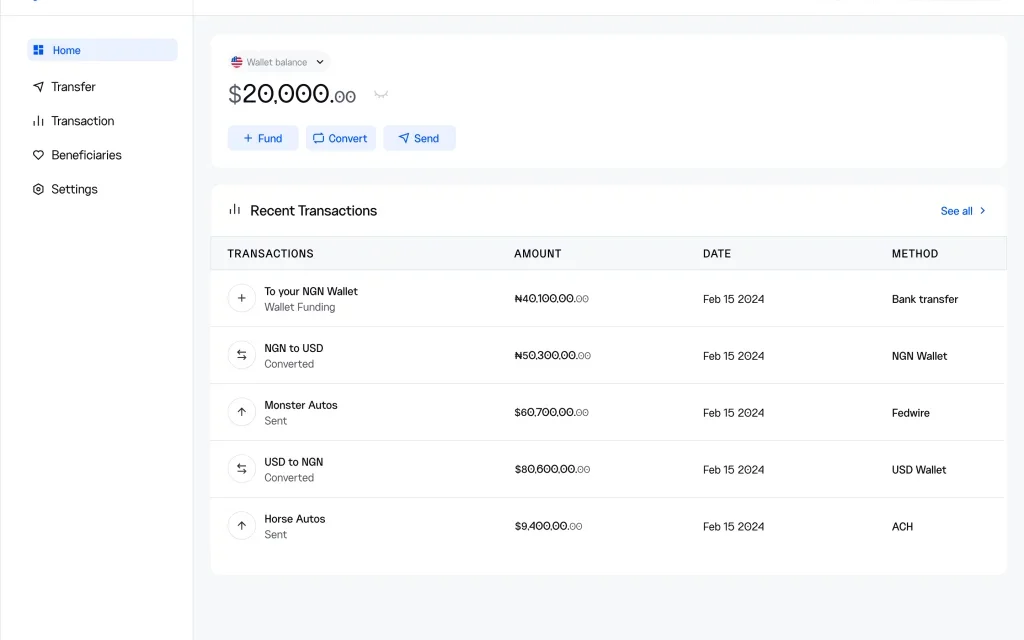
Clea permits companies to handle worldwide provider payments from a single platform. After signing up and finishing verification, a business can fund its account in naira from a Nigerian checking account, convert the funds into the required foreign money, and add its abroad provider as a beneficiary. During a stay product demonstration, Adedokun confirmed that the platform helps currencies together with the US greenback, British pound, euro, and Chinese yuan.
To add a new provider, a buyer offers particulars such because the recipient’s deal with, nation, and the character of their relationship with the beneficiary. After including the beneficiary, the shopper can provoke a fee utilizing the accessible fee routes for that vacation spot. Adedokun stated payments to US beneficiaries might undergo ACH, Fedwire or the Real-Time Payments (RTP) community, whereas payments to different locations may very well be routed by SWIFT.
Stablecoins type a part of the infrastructure Clea makes use of to maneuver worth between the totally different components of this fee course of. Adedokun stated the platform is designed to maintain this complexity out of sight, permitting clients to concentrate on funding their accounts in naira and guaranteeing suppliers obtain the agreed overseas foreign money. Customers may fund their greenback wallets straight with stablecoins, together with USDT and USDC, by supported blockchain networks.

Africa’s cross-border payments ecosystem has seen rising stablecoin use for remittances and business settlements. Flutterwave, a Nigerian payments infrastructure firm, has begun exploring an integration of USDC settlement into its payments infrastructure. In February, Onafriq partnered with Conduit to make use of USDC for cross-border payments and payouts to worldwide companions.
“Stablecoins are additionally a part of our settlement infrastructure,” Adedokun defined. “They allow value to move efficiently between parts of the payment stack, but our customers don’t need to understand stablecoins or interact with crypto. They simply know that they were funded in naira and their supplier received dollars, pounds, euros or yuan.”
In August, Clea launched a Vendor Payments characteristic for companies that frequently pay the identical abroad corporations. Adedokun stated the product emerged from a deeper understanding of buyer wants, formed by observing how companies used the platform. Clea serves wholesalers, producers, electronics distributors, style companies, equipment importers and African companies that rely upon worldwide suppliers.
“Initially, we thought speed and FX access were the biggest problems,” he stated. “ They are still very important, but once customers started using Clea repeatedly, we realised that trust, payment identity, reconciliation and supplier management are equally important.”
With Vendor Payments, clients can choose the provider from a record of preconfigured distributors whose fee info the platform maintains. They nonetheless want to offer the transaction-specific reference the provider requires, similar to a purchaser quantity or lot quantity, earlier than authorising the fee.
According to Adedokun, Vendor Payments helps US-dollar payments to chose suppliers within the United States, together with car public sale platforms Copart and IAA.
“If thousands of importers are paying the same shippers, auction companies and suppliers, it doesn’t make sense for every importer to establish that relationship independently every time,” he stated. “Once the vendor already exists on Clea, we can simplify the transaction for both sides: fewer incorrect account details, faster reconciliation, better visibility and potentially much faster settlement.”
Clea is betting on importers
Clea makes cash primarily from transaction charges and the margin between the trade fee it sources overseas foreign money at and the speed it provides clients. Adedokun stated the corporate is constructing a transaction-driven business, the place larger fee volumes and extra environment friendly infrastructure might help decrease its underlying prices and enhance pricing over time. Since its launch, Clea says it has processed greater than $50 million in payments.
“We have to be very disciplined about pricing because our customers understand FX extremely well. These are businesses moving significant amounts of money, so even a small difference in the exchange rate matters,” Adedokun stated.
Clea is competing with fintechs similar to Verto, Raenest and Grey, which provide companies multi-currency accounts and worldwide payments. In February, Olayemi Cardoso, Nigeria’s Central Bank (CBN) governor, stated that the nation’s common month-to-month diaspora remittance inflows are about $600 million, displaying the size of cross-border cash motion in Nigeria. Adedokun argued that Clea’s focus is narrower: it’s constructing across the particular wants of importers, relatively than providing a general-purpose worldwide payments product.
“We don’t think of Clea as another generic international money-transfer product. We are building specifically around the workflow of an importer,” he stated. “Our objective is to stay competitive on FX and fees while giving customers speed, reliability, transparency and proper payment documentation.”
When requested about regional growth, Adedokun stated the corporate is prioritising progress in Nigeria. Its fast plans embrace increasing the seller community, strengthening its fee infrastructure, bettering transaction effectivity and decreasing the underlying price of payments.
“There’s a temptation with an African fintech company to announce ten countries very quickly, but there is still a huge amount of market for us to capture in Nigeria,” Adedokun stated. “Our immediate priority is to deepen our presence in Nigeria, where we still see considerable opportunities to serve businesses involved in international trade. Ultimately, we want Clea to become the preferred financial infrastructure partner for African businesses trading globally.”