
The Federal Government says Nigeria is starting to alter how it’s perceived internationally, pointing to its tax overhaul and broader financial reforms as proof that the nation is transferring in the direction of sustainable development and shared prosperity.
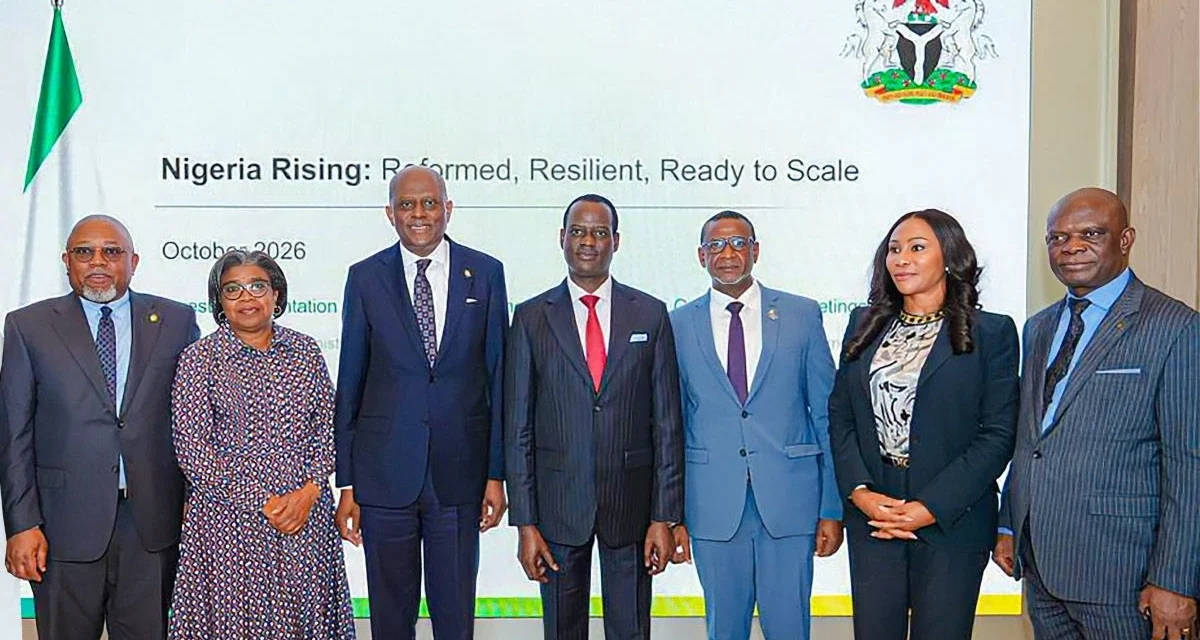
Minister of Finance and Coordinating Minister of the Economy, Taiwo Oyedele, stated this as he defined his “Nigeria rising” narrative on the 2026 IMF-World Bank Meetings in Thailand.
According to him, the Nigeria Rising narrative was designed to speak the modifications happening within the nation and problem perceptions that don’t mirror the federal government’s evaluation of its financial progress.
Speaking on the closing press briefing of the Meetingss in Bangkok, Thailand, Oyedele stated he noticed rising curiosity in Nigeria amongst worldwide stakeholders in the course of the conferences, which he attributed to the nation’s ongoing reform programme.
Tax reforms type a part of Nigeria Rising agenda
The minister stated the federal government believes its reforms are placing Nigeria on a path in the direction of stronger financial efficiency, citing modifications to the tax system and financial administration as a part of efforts to ascertain a basis for sustainable development.
The finance minister cited the overhaul of Nigeria’s tax system as one of many main reforms underpinning the Nigeria Rising narrative.
He stated the federal government had rewritten the nation’s tax framework inside two years, presenting the train as a part of broader efforts to reform public administration and enhance the financial system.
Oyedele stated the mixed impact of the reforms may put Nigeria on a path in the direction of sustainable development and shared prosperity.
- “If you put all of this together, it means one thing: that we are on the path to a celebrated growth that is sustainable, and ultimately to deliver shared prosperity to our people,” he stated.
He urged Nigerians to look past destructive headlines and pay nearer consideration to the alternatives rising from the federal government’s financial programme.
- “Everywhere you look, there’s an opportunity. But you need to look for the opportunity,” he stated.
Government targets 7% development above IMF projections
Oyedele stated the federal government expects Nigeria’s financial development to exceed the IMF’s projections of 4.3% for 2026 and 4.4% for 2027, describing the multilateral lender’s forecasts as traditionally conservative.
He stated the government was working towards a 7% growth rate, supported by measures to handle structural constraints, scale back inflation and enhance the enterprise atmosphere.
- “We expect growth that is much higher than what the IMF is projecting for Nigeria. Our target is to get to 7% growth rates,” he stated.
The minister stated the federal government had recognized areas requiring intervention and was implementing measures supposed to speed up financial exercise past the tempo mirrored in present worldwide forecasts.
However, reaching the goal would require development to speed up considerably from the charges projected by the IMF, alongside sustained enhancements in funding, productiveness and enterprise exercise.
Lower inflation and rates of interest central to development plan
Oyedele recognized meals, power and logistics prices as key sources of inflationary stress, saying the federal government was addressing these constraints to create circumstances for decrease inflation and borrowing prices.
He argued that decreasing inflation to low single digits may make single digit rates of interest doable, bettering entry to credit score for companies and supporting funding.
The minister highlighted the excessive price of borrowing as a constraint on companies, noting that some corporations had been recording development charges of about 30% whereas the broader financial system continued to develop at a a lot slower tempo.
- “Imagine that prime lending is close to 30%. Your top business is growing at 30%, and you are still growing at 4.5%. Just imagine what is possible when they borrow at a single digit,” he stated.
He additionally pointed to developments within the overseas alternate market, saying the naira’s efficiency had improved the outlook for inflation and helped ease a few of the pressures affecting the financial system.
According to him, tackling the remaining inflationary pressures from meals, power and logistics could be vital to reaching the federal government’s development ambition.
IMF raises Nigeria’s 2026 development forecast to 4.2%, initiatives 4.3% in 2027
Earlier this month, Nairametrics reported that the IMF raised Nigeria’s 2026 financial development forecast to 4.2% from 4.1% in its October 2026 World Economic Outlook, while retaining its projection of 4.3% growth for 2027.
- In its report, titled Resilience Under Strain, Urgent Choices, the Fund attributed Nigeria’s development outlook partly to improved macroeconomic stability and beneficial phrases of commerce.
- However, the IMF warned that greater costs of important items may worsen poverty and meals insecurity, regardless of the improved development outlook.
- The Fund additionally known as for focused, short-term money transfers and earnings help to assist weak households address rising meals and power prices with out undermining longer-term financial stability.
The IMF’s projections stay under the Federal Government’s 7% development ambition, highlighting the hole between the nation’s goal and the Fund’s expectations for the financial system over the following two years.