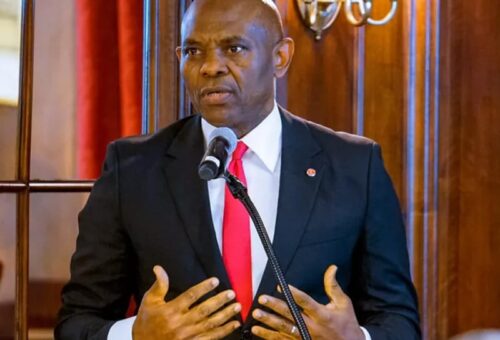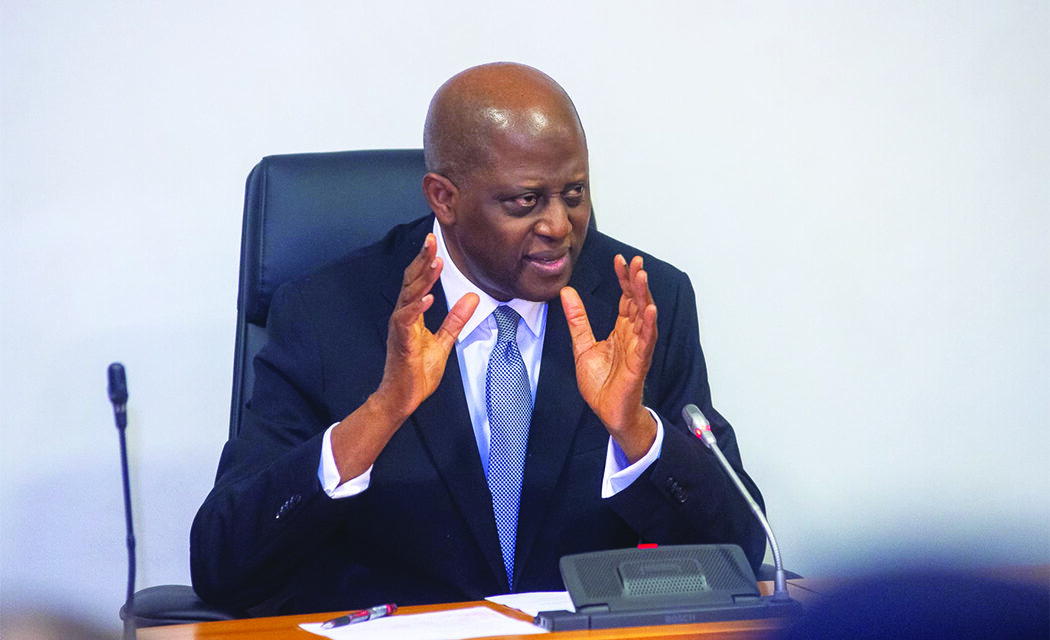
At the shut of the IMF/World Bank Annual Meetings in Bangkok, Thailand, Central Bank of Nigeria Governor Olayemi Cardoso discusses Nigeria’s financial restoration reforms to entice long-term funding and the financial coverage implications of easing inflation. He additionally examines monetary ties with China and different Asian economies, banking recapitalisation, financial coverage committee independence, and the promise and perils of synthetic intelligence. Nume Ekeghe presents excerpts
As the conferences have come to an finish, are you able to converse to the key takeaways from the IMF/World Bank Annual Meetings?
These conferences come at an vital second for Nigeria. Our financial indicators are displaying encouraging enhancements following a interval of serious coverage changes.
Headline inflation declined to 14.63 per cent in September 2026, a growth we welcomed throughout our keep right here, from roughly 34.8 per cent at the finish of 2024.
External reserves have risen above $55 billion, their highest degree in 18 years, whereas formal remittance inflows are approaching $1 billion month-to-month.
Our banking sector has mobilised N4.65 trillion in contemporary capital by means of the recapitalisation train, with simply over 70 per cent raised from home buyers. This sturdy home participation is a crucial vote of confidence in the resilience and long-term prospects of Nigeria’s banking system.
International assessments are additionally recognising the progress being made, together with Fitch’s current revision of Nigeria’s sovereign outlook from secure to optimistic. These are vital good points, and I need to acknowledge the endurance and resilience of the Nigerian individuals by means of a tough interval of adjustment. Our duty now could be to consolidate this progress and translate it into higher funding, productiveness and sustainable financial progress.
During the Annual Meetings, we engaged worldwide companions on Nigeria’s financial outlook and the challenges going through the international financial system. Together with the Honourable Minister of Finance and Coordinating Minister of the Economy, we held bilateral conferences with the IMF’s First Deputy Managing Director, Mr Dan Katz, and the President of the World Bank Group, Mr Ajay Banga.
Our discussions lined Nigeria’s coverage priorities and alternatives for continued cooperation. We additionally engaged S&P Global Ratings, Moody’s and Fitch Ratings on Nigeria’s financial outlook and the path in direction of attaining investment-grade rankings in the medium time period.
These engagements underscored the significance of coverage consistency, credible establishments and efficient coordination between fiscal and financial authorities.
Beyond these bilateral engagements, I used to be happy to contribute Nigeria’s expertise to two vital IMF discussions.
At the flagship debate on the international financial system, Forging Resilient and Dynamic Economies for the Future, I joined IMF Managing Director Kristalina Georgieva and different worldwide leaders to share classes from Nigeria’s expertise for rising economies.
For Africa, the ambition should transcend surviving crises. In an more and more unsure international financial system, we should construct economies which can be extra productive, aggressive and resilient to future shocks.
We additionally mentioned synthetic intelligence and its implications for the international financial system. Africa can’t afford to be a passive participant in the AI revolution. We should develop the capabilities to form its alternatives and seize the financial worth it creates.
At the IMF seminar titled How Central Banks Decide: Committee Decision-Making and Communication in an Era of Uncertainty, moderated by Mr Dan Katz, I mentioned the CBN’s expertise in strengthening financial coverage decision-making, transparency and communication.
Our September determination to reset the financial coverage price from 26.5 per cent to 23 per cent offered a sensible instance of the significance of credible establishments and clear coverage communication.
I additionally participated in the Group of Thirty’s worldwide banking seminar and discussions on African financial cooperation, together with progress in direction of operationalising the African Monetary Institute in Abuja.
Alongside the Annual Meetings, we now have been pursuing a broader technique to deepen Nigeria’s monetary relationships with Asia by means of a sequence of engagements throughout the area.
In Singapore final week, on our approach to Bangkok, we met with the Monetary Authority of Singapore, signed a memorandum of understanding with the Global Financial and Technology Network, and convened the Nigeria-Asia Financial Connectivity Dialogue in collaboration with JPMorgan, the Nigerian Exchange Group, and FMDQ Group.
A very vital engagement right here in Bangkok was my assembly with Mr Pan Gongsheng, Governor of the People’s Bank of China.
Our discussions targeted on strengthening monetary cooperation between Nigeria and China, significantly in cross-border funds, settlement preparations, monetary expertise and commerce finance.
We intend to construct on these discussions throughout our forthcoming go to to Beijing, with an emphasis on sensible preparations to facilitate cross-border funds, help commerce and funding flows, and strengthen monetary intermediation between our two economies.
Together, these engagements are supposed to deepen monetary market linkages and increase alternatives for financial cooperation between Nigeria and Asia.
Looking forward, our focus at the Central Bank stays firmly on value stability, sustaining financial self-discipline and safeguarding the stability of the monetary system.
We will proceed to pursue a data-dependent and well-communicated financial coverage, with single-digit inflation remaining a medium-term goal.
We depart Bangkok with stronger worldwide relationships and a clearer understanding of the alternatives forward. Our activity now could be to construct on these good points and make sure that Nigeria’s monetary system is resilient, aggressive and properly positioned to help the nation’s long-term financial ambitions.
Beyond the factors you will have already made, what are your main takeaways from these periods? What classes can Nigeria study from these discussions? Also, are you able to elaborate in your session on how central banks make selections, in addition to the broader discussions on central banking?
Generally, I’d determine three or 4 vital takeaways. First, regardless of international fragmentation and the huge headwinds skilled over the previous yr, the international financial system has weathered the challenges.
However, appreciable uncertainty and fragility stay. We can’t afford to relaxation on our laurels. Given the sequence of shocks the world has skilled, even a comparatively small shock in a single a part of the international financial system might have main repercussions elsewhere.
Second, the non-public sector is vital. Governments should create an enabling atmosphere that permits companies to make investments, thrive and create jobs.
Third, collaboration is important. There has by no means been a higher want for collaboration throughout nationwide boundaries, geographical areas, establishments, governments and the non-public sector than there may be at the moment.
The fourth level relates to the optimistic reception Nigeria has acquired throughout these conferences. You could be stunned by how carefully individuals monitor developments in numerous economies.
As you famous, I’ve participated in a number of boards with central financial institution governors from round the world. You could be stunned by how a lot they find out about Nigeria’s financial journey, the actions we now have taken, the forex and the measures which have moved the nation from disaster in direction of stability.
More particularly, I consider there’s a rising appreciation that Nigeria has handed by means of very tough instances and emerged stronger. That was evident in a few of the examples mentioned throughout the conferences, together with our financial coverage reset.
As I discussed earlier, we had been happy to obtain the newest inflation figures whereas we had been right here. The decline in inflation additional validates the place we took at the Monetary Policy Committee (MPC).
There was appreciable curiosity in Nigeria’s MPC construction, significantly the comparatively giant variety of exterior members in contrast with many different jurisdictions. There was additionally curiosity in the undeniable fact that the fiscal management has illustration on the committee.
Beyond whether or not members are inner or exterior, the most vital consideration is their character and independence of thoughts. We search for independent-minded people to serve on the MPC as a result of this helps forestall groupthink, which may simply lead to poor selections.
One significantly vital query was how we guarantee exterior MPC members have entry to data equal to, if not higher than, what inner members have. We have assigned inner useful resource individuals to every MPC member to present the needed help and knowledge.
We additionally repeatedly organise technique periods with MPC members. Currently, a gaggle is enterprise research excursions to different jurisdictions to look at how financial coverage committees function in numerous environments.
We are doing all the pieces potential to make sure that we get the greatest out of the committee. Investor confidence had deteriorated, and the nation was in a really tough place. We subsequently had to make sure that the committee introduced collectively individuals with various expertise, expertise and impartial views.
The Nigeria Investors Forum generated appreciable curiosity in the funding alternatives offered by means of the Investment Deal Room. From the CBN’s perspective, what is required to maintain investor confidence and encourage long-term capital flows into Nigeria?
I feel the reply is less complicated than it might appear: we should keep the course. The query has come up repeatedly throughout our engagements. Investors need to know whether or not we are going to stay dedicated to our insurance policies and reforms.
That is the place the reply lies. In tough circumstances, governments could be pressured to abandon their insurance policies. When that occurs, all the arduous work already undertaken could be undermined.
But we aren’t about to try this. We have come a great distance and demonstrated that the reforms can work. Stability is returning to our financial system, and we should construct on that progress. The final thing we intend to do is undermine the tough reforms we now have applied. We will keep the course.
How can African central banks and growth finance establishments work extra carefully collectively to mobilise long-term capital for Africa’s growth?
This is the place we start to respect the advantages and energy of financial stability. When stability returns, and overseas trade turns into much less of a constraint, it turns into simpler to develop monetary merchandise and funding constructions that help long-term financing.
At one level, the premium between the official trade price and the parallel-market price was roughly 60 per cent. Today, it has fallen to about 3 to 4 per cent.
These developments encourage funding and make it simpler to construction monetary merchandise round a extra secure forex and financial system.
As custodians of financial stability, we now have a duty to keep that stability. Development finance establishments, on the different hand, have a duty to channel sources into growth.
The prospects for mobilising long-term naira-denominated capital have elevated considerably on account of the stability we now have achieved in the markets. The dangers beforehand related to exchange-rate volatility and sharp forex depreciation have receded significantly. We subsequently count on growth finance establishments to play a higher function in mobilising and deploying long-term capital.
A transparent division of tasks is important. The CBN’s duty is to guarantee financial and value stability, not simply in the quick time period but additionally over the long run, whereas bringing inflation down and sustaining a secure macroeconomic atmosphere.
Development establishments, together with the Africa Finance Corporation, the Bank of Industry and the Development Bank of Nigeria, have their very own mandates to finance growth. With the improved stability we’re witnessing, it ought to change into simpler for these establishments to mobilise sources and help productive actions.
I’m happy that, with this appointment, we can be in a position to work extra carefully with the AFC. The establishment has demonstrated over time that it may well mobilise sources not solely in Nigeria however throughout Africa. We will work with it to advance this goal additional.
Developed economies seem significantly targeted on AI as a driver of worldwide financial progress, though additionally they recognise the dangers it presents. Where do you see the alternatives for Nigeria, and what main dangers ought to we be involved about?
On synthetic intelligence and the alternatives it presents, I need to make an vital distinction. AI’s affect on the creating world differs from its affect on rising markets and superior economies.
Developing nations face a special scenario. For us, it is a defining second. It might decide whether or not we obtain convergence with superior economies or fall additional behind. This isn’t just about variations between households or companies inside rising markets. It can also be about whether or not the hole between superior and creating economies widens or narrows.
Artificial intelligence presents a chance to shut that hole, offered we get it proper. I consider the first step is to develop a transparent technique. From my analysis, I’ve discovered that many African economies have but to develop complete methods to handle this problem. The danger is that the alternative will stay out there, but when we aren’t cautious, it might cross us by.
At the Central Bank, we determined a while in the past that the greatest strategy was to begin from the prime. We introduced the CBN Board along with AI specialists for an intensive dialogue on the topic. We consider the Board and administration should drive the initiative. It needs to be a top-down course of fairly than merely a bottom-up initiative.
For that to occur, these at the prime should perceive the alternatives and dangers. AI carries important cybersecurity dangers. Other dangers might destabilise an financial system, complicate financial coverage, and create challenges for monetary establishments.
AI might enhance productiveness in a number of areas, together with pharmaceutical manufacturing and the operations of small and medium-sized enterprises. Businesses have a lot to acquire by adapting and adopting these applied sciences.
There is nice potential, however acceptable safeguards have to be put in place. Collaboration should even be a part of the dialogue. We want globally aligned requirements, to the extent potential, so one a part of the world doesn’t transfer in a course basically incompatible with developments elsewhere.
There is quite a lot of work to do in the AI area after we get again to make sure that we get the greatest out of it.
You talked about that your engagements in Singapore and your upcoming go to to Beijing are a part of a broader technique to strengthen Nigeria’s monetary ties with Asia. What is driving this strategy, and what outcomes do you hope to obtain, significantly out of your assembly with the Governor of the People’s Bank of China?
We are occupied with seeing how we will deepen collaboration between establishments, together with Chinese banks, the Central Bank of Nigeria, business banks and different establishments, significantly in the funds system.
China has a strong funds system, and we’re exploring whether or not we will study classes from it. In specific, there may be appreciable curiosity in peer critiques between the People’s Bank of China and the Central Bank of Nigeria.
When we journey to China, the related groups will roll up their sleeves and look at the particulars to decide what is smart and what doesn’t. We need to keep away from a scenario wherein these engagements change into merely a chat store. I can confidently say that, simply as we’re occupied with making this work, Chinese financial institution management can also be .
Finally, keep in mind that, regardless of the appreciable liquidity out there in China, there has not been a lot funding in Nigerian monetary devices over time. This may very well be a chance to change that trajectory and generate higher curiosity from Asian markets in Nigerian devices and African devices usually.
A couple of banks haven’t accomplished recapitalisation. Banks similar to Providus and Union Bank have since consolidated and began publishing as a brand new entity. Where are we with the others? I do know some are topic to authorized orders, however how lengthy will you watch for these points to be resolved?
On the banks, the matter remains to be a piece in progress. As you rightly identified, we’re coping with sure authorized and presumably regulatory hurdles that we should clear. However, I’m assured that issues are transferring in the proper course. Quite a bit is occurring that’s clearly not for public consumption, however developments are transferring in a really optimistic course.
I’d additionally say that prospects doing enterprise with these banks ought to proceed to accomplish that. You don’t have anything to fear about; proceed your corporation with them. The banking system is robust and resilient.
You are additionally proper {that a} handful of banks stay excellent. But most banks have raised substantial capital. N4.75 trillion isn’t a small quantity. Of that quantity, roughly 72 to 73 per cent got here from home useful resource mobilisation.
That is an enormous deal. It displays the undeniable fact that Nigerians, not like in the previous after they might need been inclined to transfer their cash overseas, are actually displaying confidence of their home markets. That is one thing we would like to defend.
We have to work hand in hand with the Nigerian Exchange Group and FMDQ Group to make sure that the good points we now have achieved are consolidated.
The identical applies to the Dangote preliminary public providing. Why is there a lot curiosity from throughout the African continent? It is the identical cause: the stability introduced to the market has elevated investor confidence.
What is your view on the steadiness between satisfying the funding neighborhood and the individuals?
I feel one frequent thread that can’t be wished away when coping with markets is transparency. So far, we now have come a great distance in being as clear as potential, and that is considered one of the issues that offers buyers confidence, whether or not in Indonesia, Nigeria or anyplace else.
We should all the time watch that transparency index. These market exits don’t occur with out cause.